Time for change...
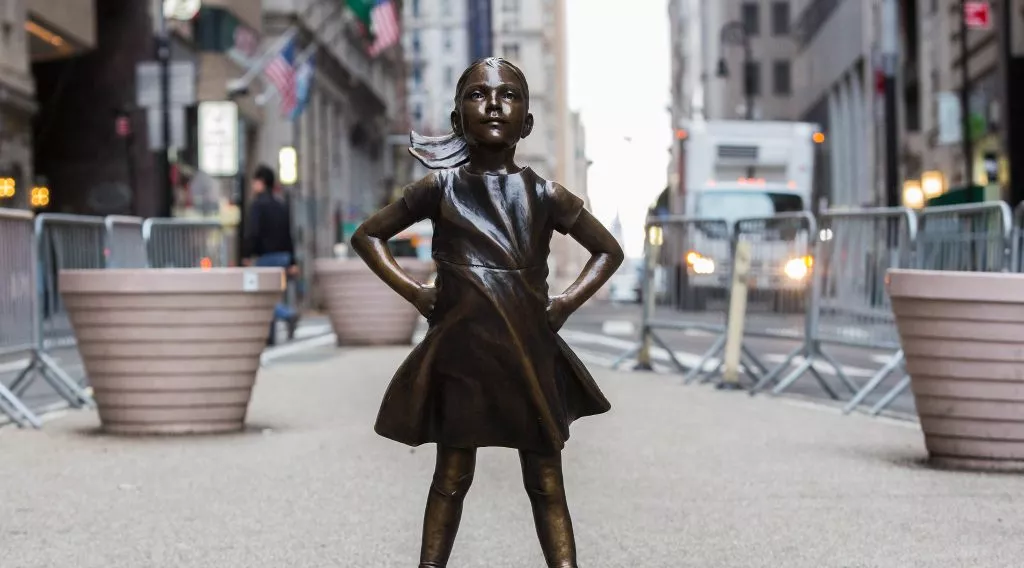
When I think about my sister and cousin working on Wall Street, I can’t help but picture the Fearless Girl statue, standing strong, staring down that massive bull. It’s such a powerful image of what women face: systems, power structures, and environments that were never really made for them. But the Fearless Girl doesn’t back down, and neither do they.
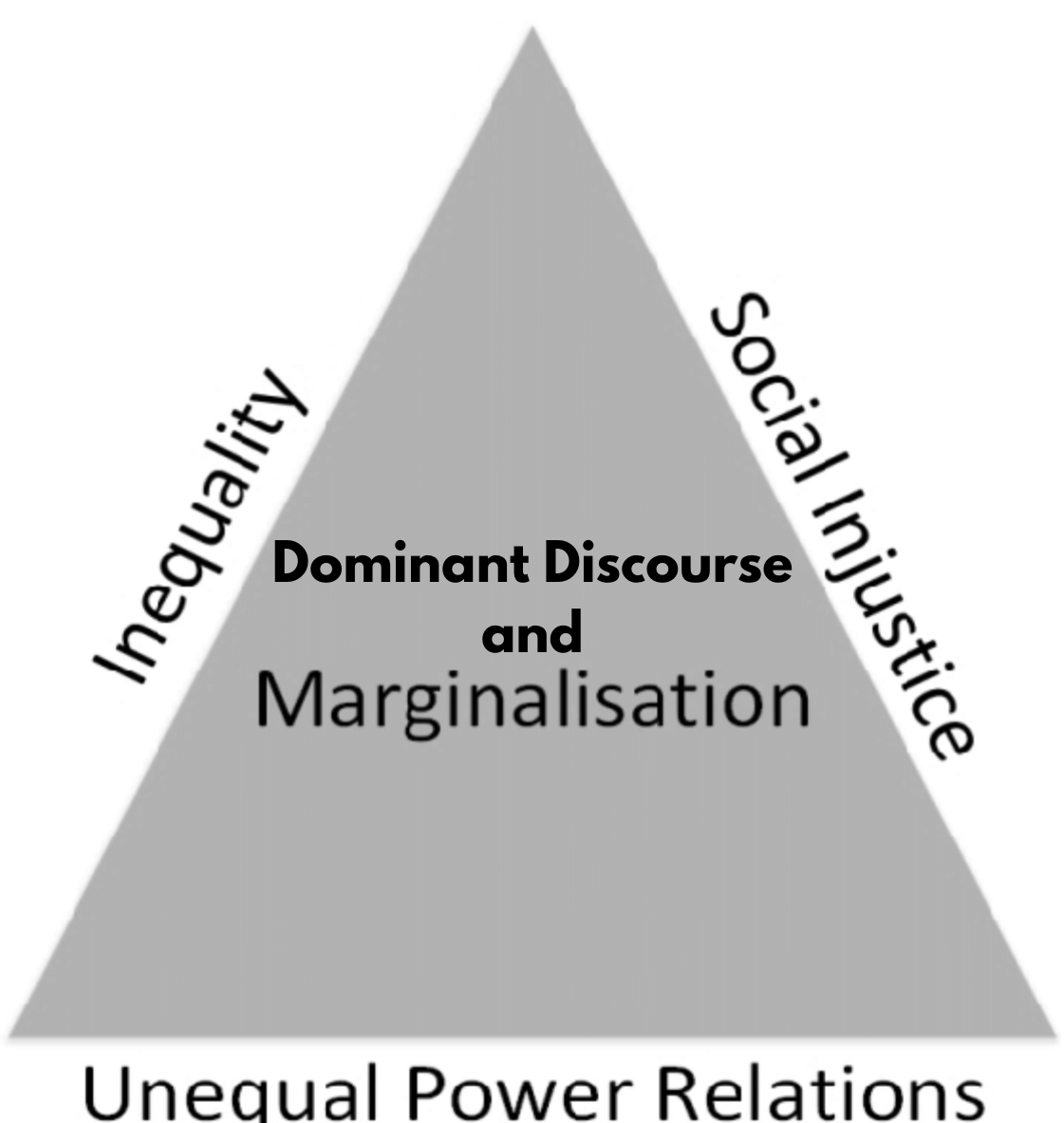
This connects so much to the theories we’ve talked about, especially dominant discourse and marginalization. The bull represents the dominant discourse, the “way things have always been.” It’s this idea that certain systems (like Wall Street) are built around male power and success, while women are left on the outside or pushed to the margins. My sister and cousin are proof of what it means to challenge that. They show up in a space where they’re often underestimated, where misogyny still lingers, and yet they refuse to be pushed aside.
As discussed later on, Teresa de Lauretis’ Queer Theory really ties into this idea of resistance and visibility. She talks about challenging cultural norms and creating space for voices that have been sidelined. That’s exactly what my sister and cousin do. They aren’t trying to blend in or be quiet; they’re carving out their space and showing they belong. It’s like the Fearless Girl: she doesn’t move, and she doesn’t shrink herself to fit in with what’s already there.
But here’s the thing, just like the statue, they still face the struggles of being marginalized. The Fearless Girl can’t erase the bull or make the system instantly equal. Instead, it highlights the fight women are still up against doubt, underestimation, and sometimes outright hostility. Celebrities like Emma Watson’s point about men struggling with feminism connects here too, people don’t like it when systems are challenged. The bull represents the comfort of power and tradition, and women standing up to that can make people uncomfortable.
Social media plays into this as well. It’s turned the Fearless Girl into a symbol, but that symbol is also a commodity. It’s easy to celebrate her strength on Instagram or Twitter without actually addressing the systems that keep women marginalized. Feminism becomes this surface-level thing,viral empowerment posts without real change. The Fearless Girl gets celebrated, but the women she represents, like my sister and cousin, still have to fight every single day.
At the end of the day, the Fearless Girl isn’t just a statue; she’s a reminder. She reminds us that women like my sister and cousin are out there, staring down systems that weren’t built for them and refusing to back down. They’re not just fighting for themselves, they’re part of something bigger, something that pushes back against dominant discourse and works to pull marginalized voices into the center. The bull might be powerful, but change happens when people are brave enough to stand in front of it and say, “This isn’t good enough anymore.”
My sister, my cousin, and so many other women I know are the Fearless Girl. They’re not just part of the conversation, they’re changing. This website is dedicated to them, Emily and Claire.
Thesis Statement
The Fearless Girl statue serves as both a challenge to the dominant discourse surrounding gender roles and an emblem of marginalization. At the same time, it exposes how feminism can be co-opted and watered down in corporate and public spaces. Social media plays a key role in this, turning the statue into a viral symbol that acts as both a commodity and a form of cultural currency, where its message is celebrated but often reduced to surface-level empowerment. By looking at it through the lens of these theories, we can better understand both its powerful message and its limitations.
II. Background of the Sculpture
The Origin Story
The Commissioning Company:
- Created by State Street Global Advisors to promote the “She Fund” initiative.
- Advocates for gender diversity in corporate leadership.
The Stance and Expression:
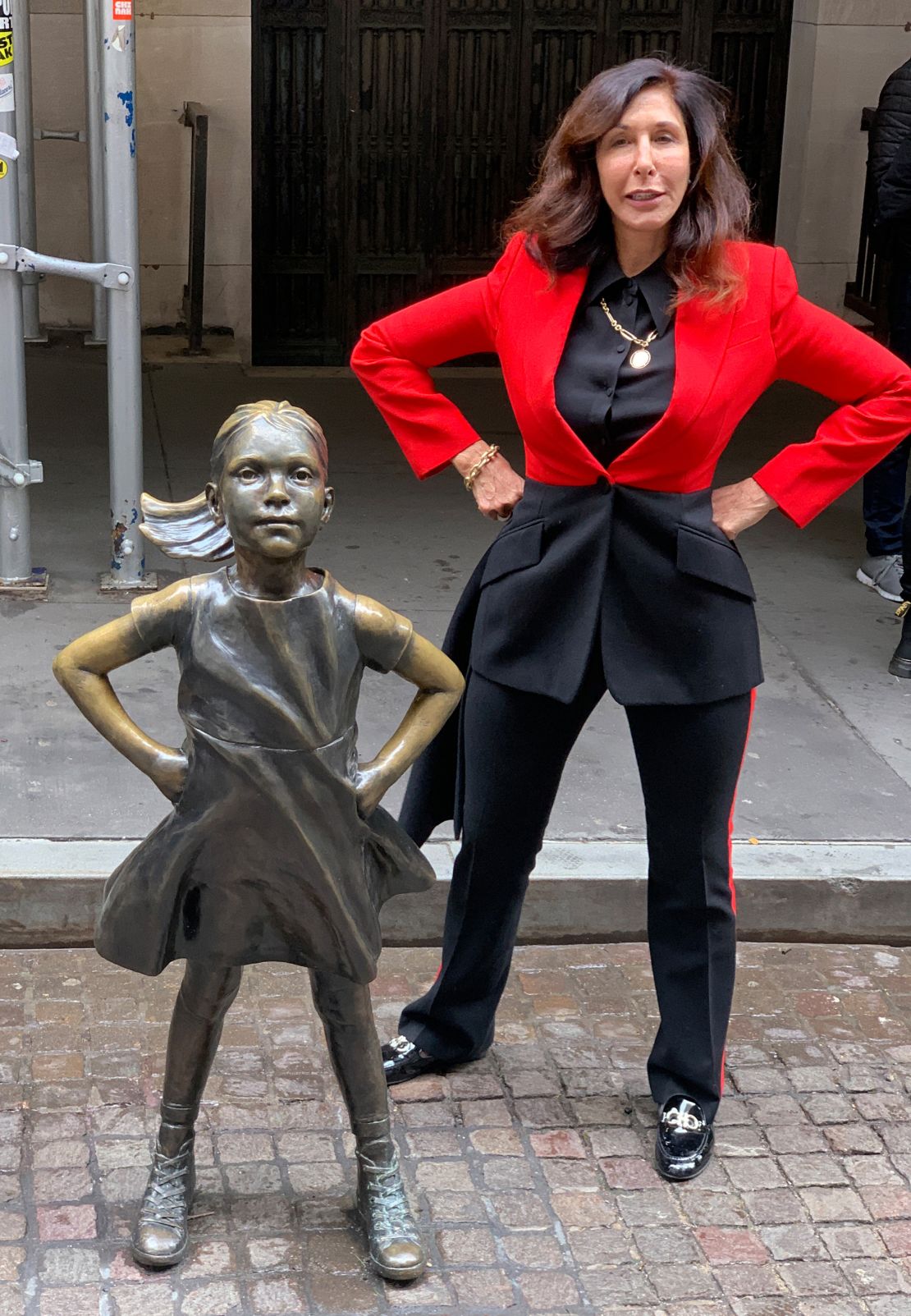
- Hands on hips, feet planted, chin raised – a pose of confidence and defiance.
- Represents strength, resilience, and hope for future generations to challenge inequity.
Public Reaction:
- Immediate global icon, sparking conversations about gender equity.
- Celebrated for empowerment; some criticism as a marketing tactic
Artist Statement:
“Fearless Girl” was intended to “call attention to the glass ceiling in the Wall Street community that so many women have faced… for promotion and for equal pay,” Visbal said. “It was a very clear and simple message.” (Visbal, CNN 2017).
Kristen Visbal, the artist behind Fearless Girl, was born in Montevideo, Uruguay. She’s an American sculptor known for creating both realistic and abstract pieces that capture movement and fine details. After studying art at Salisbury University and learning the craft of Lost Wax Bronze Casting, she set up her studio in Lewes, Delaware. Some of her other well-known public sculptures include a monument to Alexander Hamilton and Sea Express. But it’s her 50-inch bronze statue, Fearless Girl, that really put her on the map. The statue stands as a powerful symbol for gender diversity and empowerment in leadership and business, and it continues to inspire people today.
Media Frenzy: Overnight Sensation
- Social media exploded with images of the Fearless Girl standing boldly in the bull’s path. Hashtags like #FearlessGirl and #SheBelongsHere trended globally.
- News outlets hailed the statue as a “symbol of empowerment,” sparking discussions about gender equity in the workplace.
- Corporate Spin: Critics questioned whether State Street’s campaign was genuine activism or corporate virtue signaling, especially when reports surfaced about the company’s own lack of gender diversity.
Cultural Impact: Beyond the Statues
- The Fearless Girl inspired companies to pledge for greater gender equity. It became a site for protests, celebrations, and even wedding proposals.
- Artists and activists debated the ethical and artistic implications of the installation, considering whether it co-opted art for branding purposes.
Facing the Bull
1989: The Charging Bull Arrives
- Context: Sculptor Arturo Di Modica installed the Charging Bull as a guerrilla art piece near the New York Stock Exchange. It symbolized Wall Street’s resilience and economic strength after the 1987 stock market crash.
- Media Buzz: The bull quickly became an iconic symbol of financial power, representing aggressive capitalism and market optimism.
March 7, 2017: The Fearless Girl Debuts
- Context: On the eve of International Women’s Day, Kristen Visbal’s Fearless Girl statue was placed directly facing the Charging Bull. Commissioned by State Street Global Advisors, it aimed to draw attention to the underrepresentation of women in leadership positions.
- Message Shift: By juxtaposing the Charging Bull, Fearless Girl disrupted the narrative of unchecked power, introducing themes of gender diversity, inclusion, and empowerment in corporate America.

III. Broader Implications
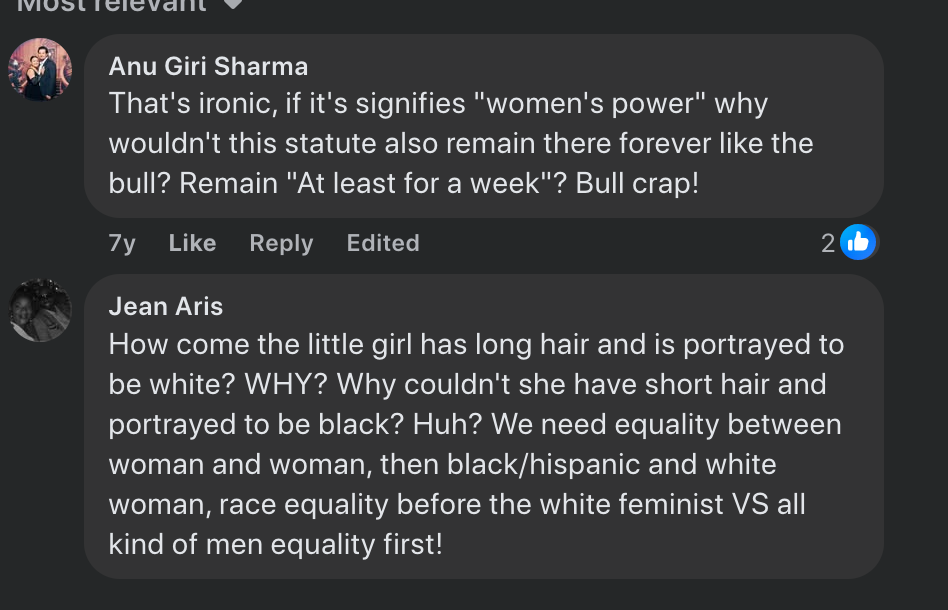
If you’ve ever scrolled through Instagram or Twitter and come across the Fearless Girl statue, you know she’s become a familiar face: a tiny figure standing tall, taking on a giant bull in the heart of a male-dominated financial district. Images like these spread fast online because they’re eye-catching and easy to share. But when symbols like the Fearless Girl go viral, something happens. Instead of being seen as a nuanced statement about power structures, they often get simplified into just another piece of social media currency, something to post, like, and move on from.
The readings I’ve explored shine a light on why this happens and what it means. Like Valoy’s discussion of transnational feminism, for example. Valoy encourages us to think about gender equality on a global scale, considering race, class, and the lingering effects of colonialism. When the Fearless Girl ends up as a feel-good post, much of that complexity is stripped away. Instead of sparking questions like, “How does this symbol relate to economic inequalities facing women worldwide?” or “How do the forces that made Wall Street so male-centric affect women of color differently?” We often just get a surface-level nod to “empowerment.”
As well as Gayle Rubin’s exploration of how societies regulate sexuality reminds us that dominant norms shape not just who we respect or include, but also what kinds of messages spread easily. On social media, the Fearless Girl looks neat and tidy, an “approved” symbol that fits neatly into a feed. But the heavier conversations, about how systems define what’s acceptable, and how marginalized groups struggle to have their voices heard, don’t translate as easily into quick, shareable posts. Instead, they risk getting lost in the shuffle.
Teresa de Lauretis’ take on queer theory and feminist rethinking pushes us further: it’s not just about adding women or marginalized groups into mainstream narratives, but reexamining the frameworks themselves. Applying her ideas, the Fearless Girl could be a moment to rethink which stories we value and why. Yet online, the story might stop at, “Look at this cool statue!” rather than, “How does this image challenge the very ideas we have about who belongs in powerful spaces?”
Even Emma Watson’s point about men struggling with feminism gets pulled into this. On social media, big structural issues can get turned into catchy soundbites. Watson’s insight, that changing systems is uncomfortable, might show up as a quick quote, stripped of the messy reality that challenging dominant discourse demands ongoing work and conversation.
In short, when the Fearless Girl hits your feed, she arrives in a world dominated by algorithms and the chase for “likes.” The complex, layered conversations that authors like Valoy, Rubin, and De Lauretis push us to have can easily slip into the background. Instead of asking what needs to change in economic policies, cultural narratives, or global relationships, we might just double-tap and keep scrolling.
This doesn’t mean social media is all bad. It’s an incredible tool for spreading awareness, and it can bring symbols of change to people who might never have seen them otherwise. But we should remember that turning a feminist icon into an online commodity, something to “spend” for social points, is not the same as digging into the real work these authors challenge us to do.
Ultimately, the Fearless Girl stands firm, and the theories we’ve read ask us to stand with her, not just in spirit, but in action. If we’re willing to slow down and engage beyond the scroll, we can transform quick clicks into meaningful dialogue, using the statue’s viral image as a doorway into deeper conversations and genuine change.
IV. Theoretical Framework
Theory 1: Transnational Feminism (Valoy)
Transnational feminism takes a global view, recognizing that gender oppression never stands alone—it’s intertwined with race, class, nationality, and the lasting effects of colonialism. This approach values intersectionality, meaning it understands that different forms of discrimination overlap and can’t be tackled in isolation. Instead of applying a one-size-fits-all model of feminism, transnational feminism acknowledges that each community’s challenges and strengths are unique.
This matters when we look at the Fearless Girl statue. She stands before a symbol of male-dominated power, calling out the dominant discourse that marginalizes women on Wall Street. But through a transnational lens, we also ask:
How does this image resonate with women facing poverty, post-colonial struggles, or cultural barriers around the world? It’s not just about one statue or one system—it’s about understanding that the fight against patriarchy and inequality is global, and that true solidarity must include all women’s voices and realities.
So What Exactly Is Transnational Feminism?
“Transnational feminists examine issues from a global perspective while considering how they intersect with our lived experiences in the United States.”(Everyday Feminism, Valoy).
.
Theory 2: Gayle Rubin’s Radical Politics of Sexuality
Rubin shows us that sexuality has long been a battleground, shaped by moral panic and restrictive laws that reinforce dominant discourse and marginalize those who don’t fit “normal” standards. From Victorian-era obsessions with purity to today’s leftover anti-obscenity laws, this policing of desire and behavior targets not just gender, but also intersects with race, class, and colonial histories—key elements in both intersectionality and transnational feminism. (Thinking Sex, Rubin).
How does this connect to the Fearless Girl statue? While the statue stands against the finance world’s male-dominated power, Rubin’s theory reminds us that similar forces have worked to control women’s bodies and sexualities across cultures and borders. Just as women are pushed to the margins on Wall Street, they’re also marginalized through sexual norms enforced by laws, cultures, and institutions worldwide. A transnational, intersectional lens shows us that these forms of control aren’t isolated—they’re part of a bigger puzzle of oppression that Fearless Girl and feminists around the globe are challenging, one stare-down at a time.
Theory 3: Teresa de Lauretis’ Queer Theory — A Feminist Rethinking
Teresa de Lauretis’ queer theory challenges the idea that sexuality is fixed and separated from other identities. Instead, it shows how sexuality, gender, and other social factors intersect, reminding us that traditional “gay and lesbian” labels often leave out women’s experiences—or treat them as afterthoughts. Like transnational feminism, this approach is about acknowledging complex identities shaped by race, class, and colonial histories.
How does this relate to the Fearless Girl statue and the themes of dominant discourse and marginalization? Just as the statue stands against a male-dominated financial world, queer theory pushes back against rigid, dominant ideas of who counts as “normal.” It’s not just about resisting a single type of marginalization—it’s about recognizing that women, queer folks, and other marginalized groups can be erased by narrow definitions of sexuality and gender. By using an intersectional and transnational lens, queer theory helps us see how the Fearless Girl and women worldwide confront multiple forms of oppression, all woven together in the complex fabric of our global society.
V. Building Your Path to Critical Thinking and Empowered Learning"
Why it matters...
Emma Watson, a long-time advocate for gender equality, once discussed why some men have trouble with feminism, pointing out that misconceptions often create barriers. Many men see feminism as a movement that attacks them or threatens their place in the world, rather than understanding it as a call for equality that benefits everyone. She emphasized that dismantling patriarchal structures isn’t just about empowering women—it also liberates men from the rigid expectations placed on them, such as emotional suppression or hypermasculine ideals.
As a brother and a cousin to women who have directly faced misogyny, this conversation hits close to home. My sister and cousin both work on Wall Street, a field that remains male-dominated, cutthroat, and often steeped in outdated gender dynamics. I’ve seen firsthand the way men—colleagues, clients, even bosses—treat them differently, sometimes subtly and other times overtly. From dismissing their ideas in meetings to inappropriate comments and even questioning their competence despite their immense talent and work ethic, these moments highlight the systemic nature of sexism.
What hits me hardest is knowing how resilient they are despite these experiences. My sister has been undermined in rooms where she was the most prepared, and my cousin has had to prove herself twice over just to get the same recognition as her male peers. It’s frustrating because these are women I look up to—sharp, ambitious, and hard-working. Yet they carry an extra weight every day, one that men like myself never have to experience.
Growing up with strong women around me has shaped how I view the world. Seeing the way they navigate spaces dominated by men has forced me to confront my own role as a man in this fight. Emma Watson’s point resonates here, feminism isn’t about attacking men; it’s about creating a system where women don’t have to fight twice as hard to achieve what they deserve. For me, it’s also about recognizing my responsibility as a brother, cousin, and man to listen, stand beside them, and challenge the behaviors and systems that perpetuate these injustices.
Feminism isn’t just women’s work, it’s everyone’s work. The experiences of my sister and cousin are reminders that we all have a role to play, especially those of us who have the privilege to speak up and challenge these dynamics. Watching them thrive despite the odds makes me proud, but it also makes me determined to ensure the next generation doesn’t face the same hurdles.
Work Cited:
- Everyday Feminism. (2015, January 12). Why we need transnational feminism. Everyday Feminism. https://everydayfeminism.com/2015/01/why-we-need-transnational-feminism/
- Rubin, G. S. (1984). Thinking sex: Notes for a radical theory of the politics of sexuality. In Culture, Society, and Sexuality (pp. 143-174). Taylor & Francis.
- De Lauretis, T. (1991). Queer theory: Lesbian and gay sexualities. Differences: A Journal of Feminist Cultural Studies, 3(2), 1-17.
- Entertainment Weekly. (2015, March 9). Emma Watson explains why some men have trouble with feminism [Video]. YouTube. https://youtu.be/4xWJf8cERoM
- TODAY. (2017, March 28). ‘Fearless Girl’ violates my rights, claims Wall Street ‘Charging Bull’ sculptor [Video]. YouTube. https://youtu.be/4xWJf8cERoM
- Holland, K. (2024, March 27). ‘Fearless Girl’ statue owner sues over NFTs of iconic image. CNN. https://www.cnn.com/style/article/fearless-girl-statue-lawsuit-nfts/index.html